
I’ve logged countless hours playing reels that deliver something distinct, and nothing catches my attention like a shifting wilds mechanic. The first time I loaded Cash of Cleopatra account access, I saw right away that its shifting wilds aren’t just a flashy add‑on. They transform how you read every spin. Instead of static symbols that sit still, these wilds shift across the grid, generating chain reactions that can convert a dead spin into a payout. I’ll guide you through exactly how shifting wilds function inside this game, what they represent for your session, and how the rest of the slot supports them. If you’ve ever thought why a moving wild matters, you’re in the right spot.
What Exactly Are Shifting Wilds and How They Function
Shifting wilds are a particular type of wild symbol that doesn’t stay locked in one position after landing. In Cash of Cleopatra, a shifting wild manifests as a glowing Cleopatra icon, and once it lands on the reels it begins a journey. On every subsequent spin, that wild moves one reel to the left, continuing until it drops off the leftmost edge of the grid. This means a single wild can contribute to wins across multiple spins, not just the one where it first appeared. I really enjoy this mechanic because it adds a layer of anticipation that makes every spin feel important. You’re keeping an eye on new symbols, but you’re also following where your existing wilds will travel next.
The real magic takes place when multiple shifting wilds are active at the same time. Because they move independently, you can end up with two or three wilds clustered together, enhancing your chances of landing a high‑value combination. I’ve had sessions where a wild that started on reel five drifted leftward and met a fresh wild on reel three, creating a chain that spanned half the grid. get more information That kind of overlap is what renders shifting wilds feel rewarding. It’s a feature that rewards patience and offers you a reason to stay engaged even during a string of base‑game spins that might otherwise feel quiet.
The Ancient Egypt Setting of Cash of Cleopatra
Cash of Cleopatra wraps its shifting wilds in a lavishly adorned Ancient Egyptian setting that seems familiar yet polished. The backdrop depicts a golden sunset over the Nile, with hieroglyph‑covered columns bordering the reels. Symbols comprise the Eye of Horus, scarab beetles, ankh crosses, and ornate playing‑card royals carved from stone. The colour palette depends largely on deep golds, turquoise, and sandy browns, which preserves the atmosphere warm and immersive without becoming visually overwhelming. I value that the design does not depend on cheap cartoon effects. Instead, it aims for a more elegant, treasure‑hunt feel.
Sound design plays a supporting role that I think many players ignore. When the reels spin, you hear a soft, rhythmic drumbeat mixed with the rustle of desert wind. Winning combinations activate a harp‑like flourish, and the appearance of a shifting wild is signaled by a distinct metallic chime that cuts through the background music. These audio cues are not simply decoration; they aid you monitor what’s happening without staring at the screen every second. For me, the theme works because it creates a consistent mood that makes the shifting wilds feel like part of an unfolding story rather than a random mechanic.
The Drifting Wilds Feature in Motion
How Moving Wilds Travel Across the Reels
When a wild lands on any reel during the base game, it doesn’t disappear after the spin resolves. In its place, it remains on the grid and shifts one position to the left on every subsequent spin. A wild that appears on reel five will shift to reel four on the next spin, then reel three, reel two, reel one, and finally leave the grid. This action happens automatically, and you can watch the wild icon physically move across the screen, which gives a satisfying visual cue. I’ve come to understand to count the remaining life of each wild, because knowing that a valuable wild has two more shifts left helps me decide whether to increase my bet a bit or stay patient.
Impact on Winning Combinations
The leftward drift of shifting wilds is well aligned with the game’s left‑to‑right payline structure. A wild that starts on reel three might not trigger a win immediately, but as it travels to reel two it can suddenly link high‑value symbols on reels one and three. I’ve witnessed a single wild cause three consecutive wins as it journeyed across the grid, each time matching with different symbols that landed on the other reels. This cascading potential is what sets apart shifting wilds from standard sticky wilds. The feature doesn’t merely keep a wild; it actively moves it to where it’s most likely to help. When multiple shifting wilds are in play, they can build temporary wild stacks that fill entire reels for a spin or two, producing the game’s most memorable base‑game payouts.
Main Game Icons and Payments
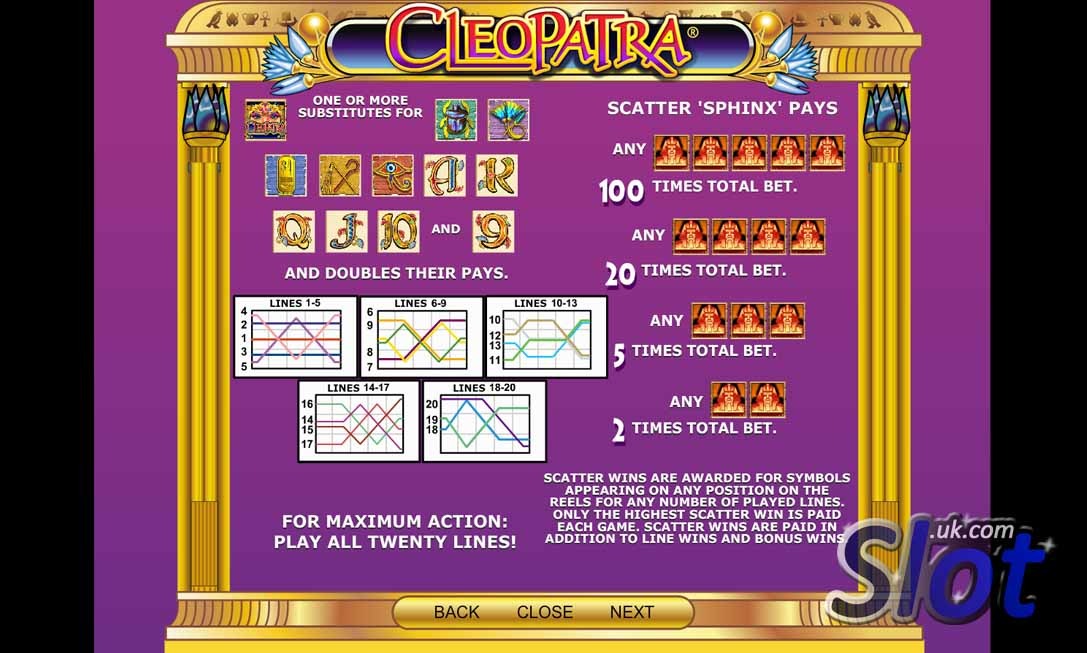
The paytable in Cash of Cleopatra is separated between high‑paying themed symbols and lower‑paying royal cards. Cleopatra herself is the top icon, offering a generous reward for five in a row, while the scarab and Horus Eye make up the middle tier. The carved A, K, Q, J, and 10 icons finish the bottom end, and they show up regularly enough to maintain your credit increasing during main game play. I consider the two of a kind rule for Cleopatra because it indicates you’re hardly ever away from at least a minor reward when her sign appears on the first two reels.

Wild symbols stand in for all normal pay icons but cannot take the place of the scatter symbol. In Cash of Cleopatra, the wild icon is also the shifting wild, which indicates every wild symbol you encounter is already in motion. This dual role renders wild icons exceptionally precious. They fill combinations on the present spin and offer later value as they change position. The scatter sign is a golden pyramid and is the critical part to unlocking the free spin mechanic. Scatters award anywhere on the reels, not just on active paylines, so hitting 3 or more guarantees a scatter prize on top of activating the bonus game. I consider that monitoring scatter frequency gives me a reliable idea of how close I am to the bonus spins function.
Reel Positions, and Winning Layout
Symbol Arrangement and Symbol Locations
Cash of Cleopatra uses a standard five‑column, three‑line setup that many slot players will consider easy from the start. There are no unusual reel shapes or expanding rows in the main game, which maintains the attention squarely on the shifting wilds and the manner in which they work with the set layout. Each reel has three symbol spots, giving you a overall of fifteen displayed spots on every spin. This familiar setup means you can quickly evaluate the location where a wild has appeared and foresee its path without needing to decode a complicated grid. I feel the ease is a strength here since it allows the changing mechanic to stand out free from any diversions.

Paylines and Successful Matches
The game operates on 20 set paylines that payout from the left side to the right side, starting from the first reel. You cannot modify the amount of working lines, which removes one choice from your arrangement and enables you to concentrate on bet size. Winning matches require at minimum 3 matching symbols on a payline, excluding for the most valuable Cleopatra symbol, which pays out for only two of a type. Since shifting wilds slide leftward, they automatically line up with the left to right payout orientation, often fulfilling or extending lines that would alternatively fall short. I’ve seen that a wild starting on reel four can rescue a pair of symbols almost‑win on reels one and 2 when it slides into reel three on the subsequent spin.
RTP and Variance: What to Expect from Every Spin
Grasping the Player Return
The theoretical return to player (RTP) of Cash of Cleopatra sits around 96%, which is right in line with the industry average for today’s video slots. That number represents the long‑term expected payback over vast numbers of spins, not what you will observe in a one session. I inform players that RTP is a theoretical indicator, not a guarantee, and immediate outcomes can swing wildly in either direction. You can verify the specific RTP by accessing the game’s information screen, where the developer is required to show it. A 96% RTP means that for each £100 staked over a vast number of spins, the game is intended to pay back £96 on average, with the operator keeping £4.
Variance and How You Play
Cash of Cleopatra operates with mid-to-high fluctuation, which directly shapes how the moving wilds feel during play. In real-world terms, you’ll experience phases where wins are scarce but the moving wilds maintain optimism, then followed by bursts where multiple wilds come together and deliver a chunky payout. This volatility profile fits my style because I like the suspense of expecting a feature to activate, but it may not suit everyone. If you favor a regular series of small wins, you could find the quiet stretches irritating. I recommend starting with lower stakes to see how the game’s rhythm matches your temperament before raising your stakes.
Stake Options and Getting Started
Getting started in Cash of Cleopatra is simple, and the betting range accommodates cautious players and those who like to press a little harder. You change your total bet per spin using well-labeled plus and minus buttons beneath the reels, with the minimum stake typically starting around 20 pence and the maximum reaching £100 or more, depending on the casino hosting the game. I suggest checking the exact limits in the paytable because different platforms can sometimes present slightly different ranges. good read The interface indicates your current bet in real currency, so there’s no confusion with coin values that demand mental arithmetic.
Before you hit spin, stop to set a session limit that matches your comfort zone. Because shifting wilds can create streaks of smaller wins while you wait for a big cluster, it’s easy to fall into a faster rhythm than you planned. I prefer to use the autoplay function with a loss limit and a single‑win stop, which lets the game run while I watch the wilds travel without constantly clicking. Autoplay settings are located in a separate menu, and you can adjust up to 100 automatic spins. Just remember that autoplay doesn’t change the odds. It only alters how you interact with the game.
Complimentary Spins and Other Special Features
Triggering the Free Spins Mode
Landing three, four, or five gilded pyramid scatter symbols anywhere on the reels gives an starting batch of free spins, with additional scatters giving you a larger starting count. Usually, three scatters award 10 free spins, four scatters provide 15, and five scatters activate 20. The scatter payout alone is boosted by your total bet and credited to your balance ahead of the feature begins. I get a small rush when the third scatter lands because the screen goes dark, the music becomes more intense, and you know the shifting wilds are going to become stronger during the free spins. Additional triggers are possible during the feature, generally by getting extra scatters, which can prolong the round considerably.
Distinct Enhancements During Free Spins
During the free spins round, shifting wilds gain an special ability that changes the feature. Rather than vanishing after they shift off reel one, these wilds become sticky for the duration of the free spins, sticking to the leftmost reel they reach. This implies a wild that travels all the way to reel one will stay there until the feature finishes, while new shifting wilds continue to come in and shift leftward. I’ve experienced bonus rounds where three sticky wilds fixed onto the first three reels, making almost every spin into a winner. Some variants of the game also apply a win multiplier that rises with each sticky wild acquired, though you need to check the game rules for the precise multiplier progression. The blend of moving wilds and constant sticky wilds makes the free spins round the highlight of Cash of Cleopatra for me.
Top Win Potential and Advice for Playing
The top payout in Cash of Cleopatra is usually limited at around 5,000 times your stake, a amount that becomes attainable almost exclusively during the free spins feature when sticky shifting wilds control the grid. To hit that ceiling, you require a perfect storm of wilds landing, shifting, and locking onto the early reels while high‑value symbols cover the remaining positions. I consider this as a long‑term target rather than something I count on to hit in every single session. The game’s medium‑to‑high volatility means big wins are feasible but need patience and a bankroll that can withstand the quieter stretches.
My recommendation is to begin with a bet size that lets you last at least 150 to 200 spins per session, because the shifting wilds mechanic pays off staying power. Set the autoplay loss limit to protect yourself from chasing, and take note to how many wilds are currently gliding across the reels. If you notice three or more wilds in motion, that’s often a signal that a cluster is forming, and I could nudge my bet up a bit to take advantage. Keep in mind that shifting wilds are a tool for entertainment, not a guaranteed income stream. Savor watching Cleopatra’s wilds glide across the screen, and just let the wins come when they’re ready.